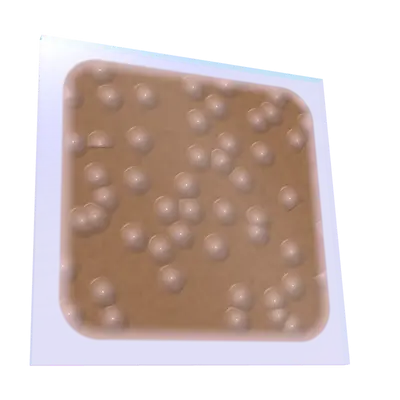
What molluscum looks like on brown and Black skin
The bumps are round, smooth and firm, like tiny pearls set in the skin. On dark skin they are skin-coloured, slightly lighter, or have a shiny, translucent look, and the central dimple is easiest to see with a light shone from the side. A child may have a handful or several dozen, grouped where skin touches skin: the sides of the chest, armpits, inner elbows, behind the knees, and the nappy area.
Patches of dry, itchy eczema often develop around them, and scratching spreads the virus in lines. When the immune system finally recognises a bump, it becomes inflamed and crusted for a week or two; this looks alarming but usually signals the beginning of the end. Healed bumps can leave a small pale or dark dot, or a tiny pit, that fades with time.
How to spot it
- Bumps are smooth, not rough like warts.
- Each has a central dimple.
- They appear in crops over weeks.
- The child is otherwise completely well.
Causes and triggers
A poxvirus infects only the outer layer of skin. It passes by direct contact, by scratching and through wet towels, sponges and bath toys. Children with eczema get more bumps because their skin barrier is weaker and they scratch.
How it is diagnosed at the clinic
Molluscum is identified by examination with a dermatoscope. No tests are needed in a healthy child.
Treatment at the clinic
- Active waiting with a moisturiser, and a mild cream for eczema around the bumps so that scratching stops.
- Removal of a limited number of bumps by gentle scraping after numbing cream, or light freezing. Both can leave temporary colour change on dark skin, so they are used selectively.
- Applied treatments that irritate the bump and prompt the body to clear it.
- Antibiotics only for true bacterial infection.
Children are seen with a parent within children’s skin care.
Prevention and daily care
- Give the child their own towel and sponge.
- Keep nails short; cover bumps that are being scratched.
- Moisturise daily if the skin is dry.
- Wash hands after touching the bumps.
Common questions
How long does molluscum last?
Each bump lasts about two to three months, but new ones keep appearing as the virus spreads on the skin. The whole episode usually ends within six to eighteen months, occasionally longer. Once it has cleared, it rarely returns.
Should molluscum be treated or left alone?
Either is reasonable. Leaving it avoids pain and the risk of marks, which matters on dark skin. Treatment may be chosen when bumps are on the face, are spreading fast, are being scratched and infected, or are distressing the child or family. The dermatologist will discuss the balance.
Can my child go to school and swim with molluscum?
Yes. Children do not need to stay away from school, nursery or swimming. Cover visible bumps with clothing or a waterproof plaster for swimming and contact sports, and do not share towels, sponges or bath water with siblings.
What does it mean if an adult has molluscum?
In adults, bumps on the lower abdomen, inner thighs and genitals are usually passed on by sexual contact, and a check for other infections is sensible. Many large bumps on the face of an adult can indicate weakened immunity, and an HIV test is recommended.
References
- NHS. Molluscum contagiosum.
- DermNet. Molluscum contagiosum.
- American Academy of Dermatology. Molluscum contagiosum: diagnosis and treatment.
- British Association of Dermatologists patient information leaflet. Molluscum contagiosum.
This page gives general health information. It does not replace a consultation, and it cannot diagnose your skin. If you are worried about a symptom, see a doctor. Read the full medical disclaimer.
Visit O.C Clinics in Oniru
| Monday–Friday | 9:00 AM–5:00 PM |
|---|---|
| Saturday | 10:00 AM–4:00 PM |
| Sunday | Closed |
