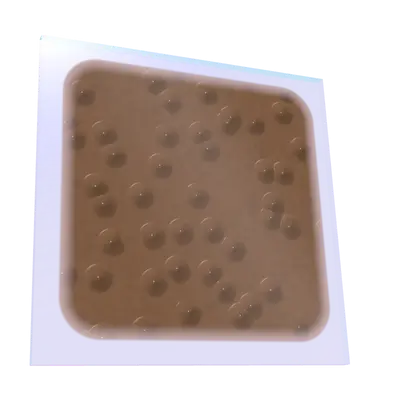
What razor bumps look like on brown and Black skin
Razor bumps are firm, skin-coloured to dark brown bumps, 2 to 5 millimetres across, centred on hair follicles. A curled hair is often visible looping into the bump. They appear on the neck, under the jaw, on the cheeks and along the beard line a day or two after shaving, and itch or sting.
On dark skin, what remains is as noticeable as the bumps themselves: a field of dark dots and patches across the shaved area. Where bumps recur for years, the neck and jawline can develop thick, raised scars and keloid scars.
The same problem affects:
- the back of the scalp and neck after a close haircut; see scalp folliculitis
- the bikini line, underarms and legs
- the chin in women who pluck or shave
How to spot it
- Bumps appear after shaving, waxing or plucking, not at random
- They are confined to the area where hair is removed
- You can see or feel a hair trapped in some bumps
- They improve when you stop shaving and return when you start
- Dark marks follow each crop
Bumps with pus that spread beyond the shaved area, or that do not improve when shaving stops, may be bacterial folliculitis, acne or a fungal infection, and need different treatment.
Causes and triggers
Razor bumps are a reaction to the person’s own hair, not an infection. Two mechanisms are involved:
- The hair re-enters the skin from outside. A short, sharp, curved hair grows out, curls and pierces the skin a millimetre or two away.
- The hair pierces the follicle from inside. When skin is stretched during a close shave, the cut hair retracts below the surface and its tip pushes through the follicle wall.
Things that make them more likely:
- multi-blade razors, which lift and cut the hair below skin level
- shaving against the direction of growth
- pulling the skin taut
- dry shaving and blunt blades
- plucking and waxing, which leave a sharp new hair inside the follicle
- shared or dirty clippers, which add infection
Jobs and uniforms that require a clean shave are a common reason men cannot simply grow a beard. A dermatologist can provide a medical letter where that is appropriate.
How it is diagnosed at the clinic
The diagnosis is made by examining the skin and seeing ingrown hairs, often with a dermatoscope. A swab is taken if there is pus, and a fungal test if the bumps do not fit the usual pattern. See men’s and women’s skin health.
Razor bumps treatment at the clinic
Step 1: change hair removal. This is the treatment; everything else supports it.
- Best: grow a beard, or keep stubble with clippers at about 1 millimetre.
- If a shave is required: wash with warm water, use shaving gel, shave in the direction of growth with a single-blade razor, do not stretch the skin, do not go over the same area repeatedly, rinse and moisturise. Shave every two to three days at most.
- Depilatory creams dissolve hair bluntly and suit some people, but they irritate; test a small area first.
Step 2: calm the skin. The dermatologist may prescribe a retinoid to keep follicles open, benzoyl peroxide or an antibiotic lotion for inflamed or infected bumps, and a mild anti-inflammatory cream for a few days after shaving.
Step 3: treat the marks. Pigment-fading creams, sunscreen and a series of chemical peels lighten dark spots once new bumps have stopped.
Step 4: reduce the hair. Laser hair removal with a long-wavelength laser suited to dark skin thins and reduces beard, neck or bikini hair. Clinical studies in men with dark skin show a marked fall in bumps after a course. Men who want to keep a beard can have only the neck and cheek line treated. Our article Is laser hair removal safe on dark skin? explains the precautions.
Raised scars and keloids are treated with steroid injections; see keloids.
Prevention and daily care
- Never shave dry. Soften the hair with warm water for a few minutes first.
- Change blades often; clean clippers with disinfectant after every use.
- Each night, wash the beard area with a soft cloth in a circular motion to free hairs that are starting to turn in.
- Moisturise after shaving with a fragrance-free product.
- Use your own clippers at the barber.
- Wear sunscreen on areas with dark marks.
Common questions
How do I get rid of razor bumps permanently?
The only ways to stop them for good are to stop shaving closely, so that hairs grow long enough not to re-enter the skin, or to reduce the hair with laser. Creams and correct shaving technique control bumps but they return if close shaving resumes. Laser hair removal gives the most lasting relief.
What is the fastest treatment for razor bumps?
Stop shaving for three to four weeks and let the hairs grow out; most bumps settle as trapped hairs free themselves. A dermatologist can prescribe creams to calm inflammation and treat infection meanwhile. Do not dig hairs out with pins or tweezers, which causes scars and dark marks.
Why do Black men get razor bumps?
Tightly curled hair grows from a curved follicle. When it is cut short at an angle, the sharp tip curls back towards the skin and pierces it, or it retracts and pierces the follicle wall from inside. The skin reacts as it would to a splinter. Most men of African descent who shave closely are affected to some degree.
Which is better for razor bumps: clippers or a razor?
Electric clippers or a trimmer that leaves about one millimetre of stubble cause far fewer bumps than a blade, because the hair is not cut below the skin surface. If a razor is needed, a single-blade razor used with the grain, without stretching the skin, is the next best choice.
Do razor bumps leave dark marks?
Yes. Each inflamed bump can leave a dark spot that lasts for months on brown and Black skin, and repeated bumps on the neck and jaw can form raised scars or keloids. Preventing the bumps is the best way to prevent the marks; existing marks are treated with pigment creams and peels.
Can women get razor bumps?
Yes. They are common on the bikini line, underarms, legs and chin in women who shave, wax or pluck, particularly with curly hair. The same principles apply: gentler hair removal, treatment of inflammation and, for lasting relief, laser hair removal.
References
- DermNet. Pseudofolliculitis barbae.
- American Academy of Dermatology. Razor bumps: how to treat and prevent them.
- NHS. Ingrown hairs.
- Dermatologic Therapy. Pseudofolliculitis barbae: review and update on new treatment modalities.
- Dermatologic Surgery. Treatment of pseudofolliculitis barbae with laser hair removal: a systematic review.
This page gives general health information. It does not replace a consultation, and it cannot diagnose your skin. If you are worried about a symptom, see a doctor. Read the full medical disclaimer.
Visit O.C Clinics in Oniru
| Monday–Friday | 9:00 AM–5:00 PM |
|---|---|
| Saturday | 10:00 AM–4:00 PM |
| Sunday | Closed |
