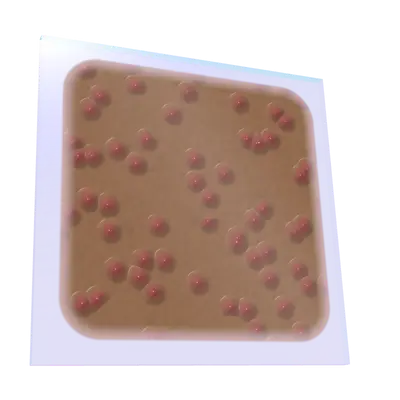
What acne looks like on brown and Black skin
On dark skin an inflamed spot is often brown, violet or the same colour as the skin, and tender, instead of bright red. What stands out more is what follows: a flat dark mark where each spot was. Many people come to the clinic for these marks, called post-inflammatory hyperpigmentation, without realising that mild acne underneath is still producing them.
Other patterns seen often in Lagos:
- Small, uniform bumps on the forehead and temples from hair oils and pomades (“pomade acne”).
- Sudden crops of identical bumps on the face, chest or back after steroid creams or bleaching products.
- Deep, painful lumps along the jaw and chin in adult women, flaring before periods.
- Spots on the back, chest and buttocks, worse with sweat, tight clothing and heat.
- Raised scars or keloid scars on the chest, shoulders and jawline after severe acne.
How to spot it
You probably have acne if you have several of these:
- blackheads or whiteheads, particularly on the nose, forehead and chin
- pimples that come in cycles, with new ones as old ones heal
- spots on the face together with the chest, shoulders or back
- oily skin
- dark marks left behind in the same areas
Bumps that are all the same size and itch may be fungal folliculitis. Redness and bumps on the cheeks and nose without blackheads, after the age of 30, may be rosacea.
Causes and triggers
Four things happen together: oil glands make more oil, dead cells block the follicle, a skin bacterium multiplies in the blocked pore, and the area becomes inflamed. Hormones called androgens drive the oil glands, which is why acne starts at puberty and why it flares with the menstrual cycle.
Things that make it worse:
- Heat, humidity and sweat, which are constant in Lagos
- Thick creams, shea butter, cocoa butter and hair oils on acne-prone skin
- Steroid creams and lightening products
- Picking and squeezing
- Some medicines, including steroid tablets, some contraceptive injections and body-building supplements
- Friction from helmets, masks, tight collars and bra straps
- Stress and poor sleep
Diet plays a smaller part than most people think. Our article Does food cause acne? sets out what the evidence shows.
How it is diagnosed at the clinic
Acne is diagnosed by examining the skin. The dermatologist notes the types of spot, how deep they are, whether there is scarring and how your skin pigments. You are asked about your periods, medicines, hair and skin products. Tests are needed only in particular situations: hormone blood tests if a hormonal condition is suspected, a swab if an unusual infection is possible, and blood tests before and during some tablet treatments. See diagnostic tests.
Acne treatment in Lagos: what the clinic offers
Treatment is matched to severity and adjusted at review.
| Severity | What it looks like | Usual treatment |
|---|---|---|
| Mild | Blackheads, whiteheads, a few pimples | Retinoid cream or gel, often with benzoyl peroxide |
| Moderate | Many inflamed pimples; chest or back involved | Topical treatment plus a limited course of antibiotic tablets, or hormonal treatment for women |
| Severe | Deep nodules, cysts, scarring | Isotretinoin tablets with monitoring |
Supporting treatments:
- Pigment control from the start: sunscreen and prescription creams that calm pigment cells, so marks fade as the acne clears.
- Chemical peels with salicylic acid for blocked pores and dark marks.
- Medical facials for careful extraction of blackheads.
- LED light therapy as an addition for inflamed acne.
- Steroid injection into a single large, painful cyst to settle it quickly.
- Scar treatment once acne is controlled; see acne scars.
Isotretinoin is highly effective but must never be taken in pregnancy and needs blood tests and regular review. Antibiotic tablets are used for a limited time and always with a cream, to limit resistance. Medicines are dispensed by the clinic’s dermatology pharmacy, and follow-up can be by online consultation. Our article How long does acne treatment take to work? explains what to expect month by month.
Prevention and daily care
- Wash the face twice a day with a gentle cleanser; more often strips the skin and increases oil.
- Use a light, non-comedogenic moisturiser, even on oily skin.
- Apply a gel or fluid sunscreen every morning. It protects against dark marks.
- Keep hair oils and pomades off the forehead; wash pillowcases and headscarves weekly.
- Shower soon after sweating and wear loose cotton on the back and chest.
- Apply treatment to the whole affected area, not single spots.
- Give each treatment at least eight weeks.
For home care in more detail, see How to get rid of pimples.
Common questions
What is the best treatment for acne?
There is no single best treatment; it depends on the type and severity. Mild acne usually responds to a retinoid cream with benzoyl peroxide. Moderate acne often needs a short course of antibiotic tablets or, for women, hormonal treatment. Severe or scarring acne is treated with isotretinoin under a dermatologist's supervision.
How long does acne treatment take to work?
Most treatments need six to eight weeks before improvement shows and three to four months for a full result, because they work by preventing new spots. Skin may look slightly worse in the first weeks. Stopping early is the commonest reason acne treatment fails.
Why do I still get acne as an adult?
Adult acne is common, especially in women, where it tends to affect the jawline and chin and flare before periods. Hormones, stress, cosmetics, hair products and some medicines contribute. Sudden severe acne with irregular periods or extra facial hair should be checked for a hormonal cause such as polycystic ovary syndrome.
Does acne go away on its own?
Teenage acne often settles by the mid-twenties, but it can last for years, and waiting carries a cost: every inflamed spot can leave a dark mark or scar. On brown and Black skin those marks often last longer than the acne, so early treatment is worthwhile.
How do I get rid of dark spots left by pimples?
Treat the acne first, or new marks will keep forming. Use sunscreen daily and do not pick. Retinoids and prescription pigment creams speed fading, and a series of superficial chemical peels helps. Most marks fade over several months. See our guide to hyperpigmentation and dark spots.
Can a pharmacist's cream cure my acne?
Some pharmacy products help mild acne. Avoid mixed creams containing steroids, which are widely sold in Lagos for spots: they calm skin for a few days, then cause more acne, thinning and discolouration. If acne has not improved after two months of a pharmacy product, see a dermatologist.
References
- NHS. Acne.
- American Academy of Dermatology. Acne: diagnosis and treatment.
- DermNet. Acne.
- Journal of the American Academy of Dermatology. Guidelines of care for the management of acne vulgaris (2024).
- Journal of Dermatological Treatment. Acne in skin of colour: practical approaches to treatment.
This page gives general health information. It does not replace a consultation, and it cannot diagnose your skin. If you are worried about a symptom, see a doctor. Read the full medical disclaimer.
Visit O.C Clinics in Oniru
| Monday–Friday | 9:00 AM–5:00 PM |
|---|---|
| Saturday | 10:00 AM–4:00 PM |
| Sunday | Closed |
